
Artificial grass in Wakefield
A lawn that stays a lawn through a Yorkshire winter. No mowing, no watering and no weedkiller, and it is the base underneath it that decides whether it still lies flat in five years.
What it is good at
More people are laying it every year and the reasons are practical rather than fashionable. It is usable all year instead of being off limits from November to March. It does not need cutting, watering or treating. Children and dogs can be on it in the morning and nobody is carrying mud through the kitchen at lunchtime. On a small garden, a shaded garden or a north facing strip where real grass has never taken properly, it does the one thing real grass could not manage.
We will also tell you what it is not. It gets warm in strong direct sun, more so than grass. It is not a home for anything, so if a wildlife garden is what you are after, real turf and a border is the honest answer. And it will not solve a drainage problem underneath it. Cheap turf laid on a thin base looks cheap almost immediately, which is why the base gets most of the days on our quotation.
Three turfs to pick from
They are not simply better and worse, they are different products for different uses, so think about how the lawn is going to be used before you look at colours. Playing Field is the one for play and family time, built to take being run about on. Summer Lawn and Village Green are multi-toned, with more than one shade of green and a hint of thatch through the pile, which is what stops artificial grass reading as a flat green carpet from the kitchen window. Look at density and pile height as well as colour, and always look at a sample outside in daylight rather than under a showroom light.
The base is most of the job
Anyone can roll turf out. What you are paying for is what happens over the days before that. The existing lawn and topsoil come out, because soft organic ground under artificial turf settles into hollows and every one of them shows. Then a membrane goes down to stop anything growing up through, then stone compacted in layers, then a screeded layer of grit or sharp sand brought perfectly flat and to a fall. Only then does the turf go on, with the pile all running the same direction, joins taped and glued rather than overlapped, edges fixed all round, and the whole lot brushed up so the fibres stand.
Living with it
Give it a brush now and then to lift the pile, especially where the furniture stands. Keep leaves off it in autumn so they do not break down into a layer that weeds can seed into. Hose it down when it needs freshening. Keep anything genuinely hot well away from it, so no disposable barbecue on the lawn. That is about the whole of it.
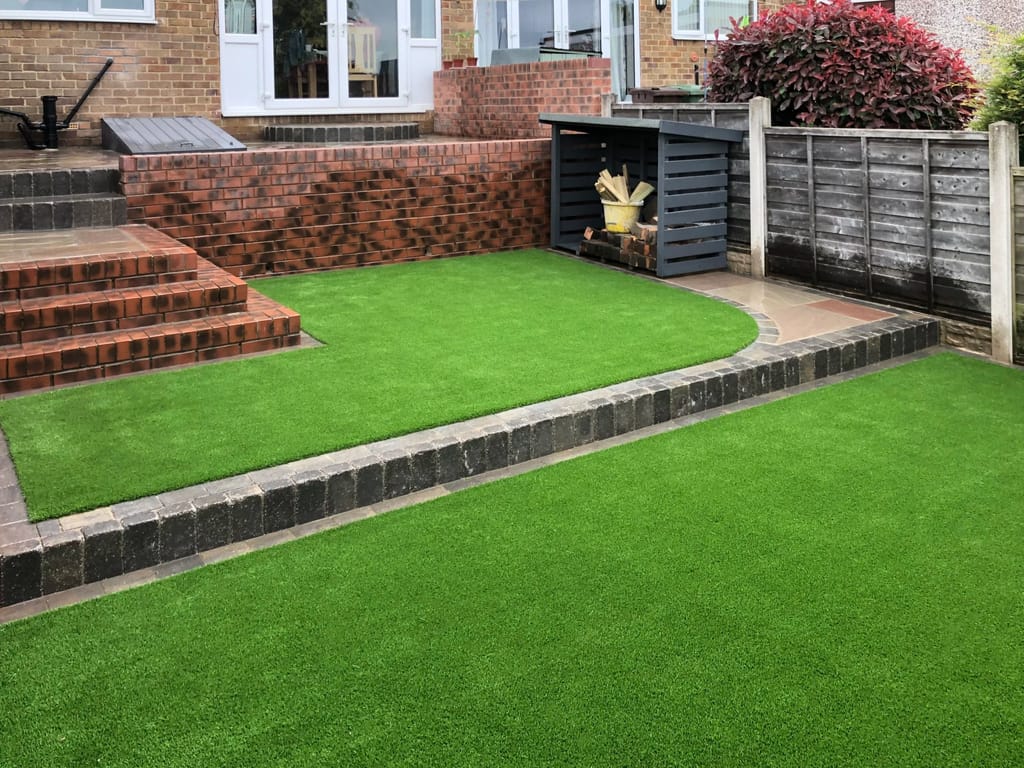
Artificial grass usually goes in alongside other work, because a lawn needs an edge and an edge is a hard landscaping job. It often gets laid off the side of a new patio, held by a low retaining wall, or run up to a flag path. There are finished gardens in the gallery.
Questions we get asked about this
Is it alright with a dog?
It is, and dogs are half the reason people ask us for it, because a lawn with a dog on it in February is mud. The turf itself is pet friendly and the pile does not care. What matters is what is underneath it, because that is what has to let liquid through and dry out. A free draining stone and grit base with a permeable backing on the turf handles it. Rinse it down every so often with a hose, pick solids up the same as you would off grass, and it stays fresh. Where a dog is a heavy digger we will talk to you about how the edges are fixed before you order anything, because edges are the one place a determined dog can get a grip.
Where does the rain go?
Straight down through the perforated backing, into the grit layer, into the stone base and away into the ground beneath, provided the ground beneath can take it. That last part is the bit that gets skipped. If you have a garden that already sits wet all winter, laying turf over the top of it does not fix the drainage, it just hides the puddle. So we look at where the water goes now before we quote, and if it needs a soakaway, a land drain or a fall built into the base to carry water off to a border, that goes on the quotation rather than turning up as a surprise the first wet week.
Does it need an edge, or can it just meet the border?
It needs something to be fixed to, and the edge is where cheap installations give themselves away within a year. Turf that just runs out into a soil border lifts at the corner, kicks up when somebody catches it, and lets weeds in from the side. We finish against something solid: a block or sett course bedded on concrete, the edge of a patio, a timber batten pinned into the base, or the face of a wall. The turf is then fixed to that edge all the way round. It costs a little more at the start and it is the difference between a lawn that still looks laid in five years and one that has curled at every corner.
Get a price for your lawn
Tell us roughly how big the garden is, what the ground is like now and who will be using it. We come out, look at the drainage and put a written price together at no cost.