
Tarmac driveways in Wakefield
More of our drives go down in tarmac than in anything else. It covers a big area quickly, it takes a car well, and on a long drive or a shared entrance there is not much that beats it.
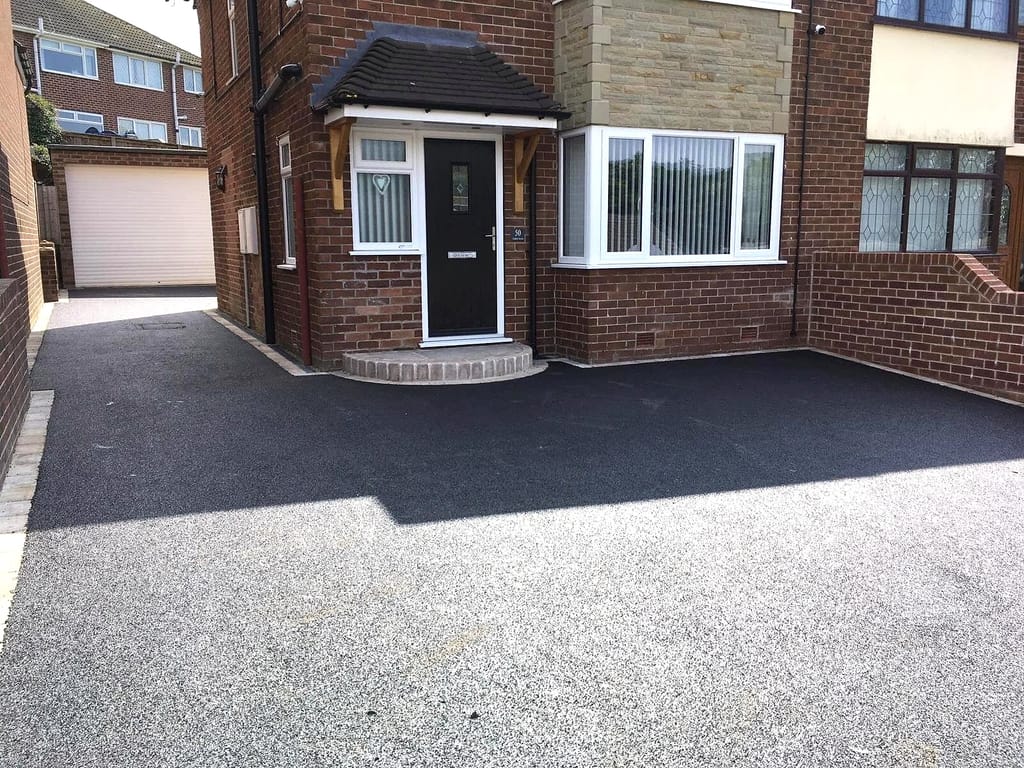
Why people pick tarmac
It comes out as one continuous surface. No joints to work loose under a heavy wheel, no pattern to drift out of line across a big area, and no jointing sand to top up every couple of years. It takes weight well, it is quiet to walk and drive on, and a dark surface makes a frontage look bigger while letting the house and the planting do the talking. Laid hot in a base course and a wearing course and rolled while it is still hot, it goes down fast once the ground underneath is right. The surfacing itself is laid by our partners, onto the base we have built.
Where tarmac wins, and where blocks do
Tarmac earns its place on long drives and shared entrances, on big open frontages, and anywhere a vehicle heavier than a car uses regularly. It is also the honest answer on a drive where the budget will not stretch to covering the whole area in block properly. A well built tarmac drive beats a block drive laid thin over a skimped base, every time, and if the ground and the money only allow one of those to be done right we will say so.
Blocks win on a short drive you look straight at from the pavement, on anything that might need lifting and relaying later, and where you want colour and a pattern. Those trade-offs are set out on the driveways page alongside natural stone. Plenty of jobs end up as both: tarmac over the bulk of the area with a block or sett border and an apron at the entrance, which gives you the edge detail without paying to cover the lot.
What actually decides whether it lasts
Two things, and neither of them is the surface. The first is the base. Tarmac is only ever as flat as what it was rolled onto, so the ground comes out to formation and the stone goes back in compacted layers rather than one thick dump, graded to fall away from the house.
The second is the edges. A roller can only compact material that is held in place, so an edge left open to a lawn or a border never reaches the same density as the middle. That is where a drive starts to go: loose grit first, then a nibbled edge, then a crumbling line a foot in. Every drive we build gets a concrete edging or a kerb bedded and haunched before any surfacing goes near it, including across the mouth of the drive where the wheels cross it every day. It is the least visible part of the job and it is the part that decides how the drive looks in year eight. Ask every firm quoting you how deep they are digging and what the edgings are bedded on.
The weather decides the day, not us
Tarmac has to be laid and rolled while it is still hot. A downpour halfway through is a losing battle, and so is a hard frost in the ground underneath. Rather than lay something that has to be come back to, we move the day and you get a phone call about it. Groundwork carries on either way, so the dig, the sub-base and the edgings can all be going in while we wait for a dry warm run at the surface.
How the job runs
- Survey. Measure up, check the fall, find out where the water goes and what is under the existing surface.
- Dig out. Down to formation. On a drive that has been made up over the years this is where the surprises live.
- Sub-base. Stone in layers, compacted between each one, graded to fall away from the house.
- Edgings. Set on concrete and haunched, so the roller has something solid to compact against.
- Drainage. Channel drains, a soakaway or a border to take the run-off, sorted before the surface goes on.
- Surface. The base course and the wearing course go down hot and are rolled while they are still hot.
- Finish. Edges cleaned off, site swept, aftercare explained before we leave.
Keeping it right afterwards
Tarmac asks less of you than block does. Keep diesel, petrol and engine oil off it, because they soften the binder and leave a soft patch that picks up. Go steady with a pressure washer, since a narrow lance held close will strip the surface grit. Lift moss on the shaded side before it holds water against the surface all winter. If a corner ever does get damaged, it is cut out square and patched, which is a small job rather than a relay.
Front garden rules and dropped kerbs
Tarmac is not a permeable surface, so a new front garden drive over five square metres either needs the water taking to a lawn, a border or a soakaway inside your own boundary, or it needs planning permission. We design the falls and the drainage at the quotation stage so the drive meets the rule. If a car has to cross the footway to get to it, the crossing is a separate application to Wakefield Council, which covers every town we work in. There is more on both on the driveways page.
Tarmac drives run into the rest of the frontage, so walling, steps and a path are worth pricing while the machines are on site. There are finished drives in the gallery, and how we quote explains what the written quotation covers.
Questions we get asked about this
How soon can we park on a new tarmac drive?
It goes off as it cools rather than curing over weeks like concrete, so it is normally fine to drive on the day after it is laid, and we will tell you on the day what your particular drive wants. The thing to be careful of is the first few weeks in warm weather, when the surface is still tender. Turning the steering hard while the car is stood still will scuff it, a caravan jockey wheel or a motorbike stand will press a dent in it, and a skip dropped on it will leave four marks that never come out. Put a board under anything with a small foot. After a summer it has hardened off and stops being fussy.
How long is a tarmac drive on site?
A normal domestic drive is a week to a few weeks on site, and you get the run of days in the written quotation so you can plan the car around it. Most of that time is the part you do not see: digging out to formation, carting the spoil away, building the sub-base up in compacted layers and setting the edgings on concrete. The surfacing itself is quick by comparison, which is one of the reasons tarmac suits a big area. What we will not do is start yours, disappear onto another job and come back the following week.
Can tarmac go over what is already there?
Sometimes, and we will tell you honestly which you have. If the existing surface is genuinely sound, flat and still draining, an overlay is worth talking about. If it is cracked, if it has sunk in the wheel tracks, or if the water is running the wrong way, then covering it only hides the problem for a winter or two, because cracks in a slab have a habit of coming back up through new tarmac in the same place. What we will not do is skim over something to save a day on the dig and let you find out later.
Get a price for your tarmac drive
Tell us the postcode and roughly the size of the area. We come out at a time that suits you, measure up and put the price in writing. The visit costs nothing and there is no deposit. Our Google rating is 5.0 from 25 reviews.