
Steps and safe access in Wakefield
Bullnose entrance steps at the front door, and garden steps between levels at the back. Built off a footing, with the risers even the whole way up, because that is what stops people catching a toe in the dark.
The front step gets more use than anything else you own
Every delivery, every school run, every visitor, every trip out to the car. It also tends to be the oldest bit of hard landscaping on a house, so it is often a worn concrete lump with a chipped nose and a lean on it. Replacing it is a small job with an effect out of proportion to its size: a bullnose stone step, a semicircle or a squared one to suit the door, with a sett or block edging round it and the path brought up to meet it properly. People notice their own front door again.
Even risers, every time
This is the whole trade secret and it is not much of a secret. Your foot learns the height of the first step and then expects it. One riser that is 20mm different from the rest is the one people trip on, and it is nearly always the last one at the top, where somebody has run out of room and taken the difference out of the final step. So the flight gets set out on paper first: total rise, divided into equal steps, treads worked back from that, and if the numbers do not come out evenly then the landing moves or the flight gets longer. Not the last riser. It costs nothing to do it in the right order.
Safe access for the elderly and anyone unsteady
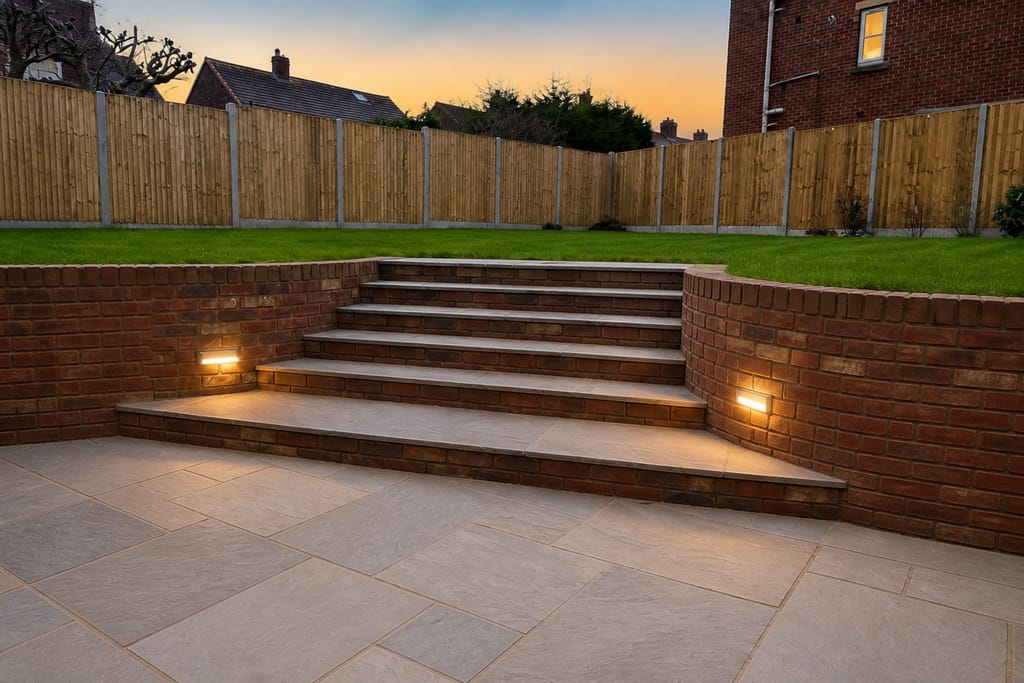
This is work we take seriously, and we say so on our own site because it comes up so often. If somebody in the house uses a stick, a frame or a wheelchair, or is simply not as steady as they were, tell us at the survey and it changes the design rather than being an afterthought. Two shallow steps instead of one tall one. A wider flight so there is no aiming at it. A landing at the top with room to stand square and turn a key. Handrail fixings set solid on both sides if that is what is wanted. Lighting ducted in as we build the steps, so the treads are lit rather than the whole garden. Where there is the room and a gentler approach is the better answer than steps at all, we will say so.
Garden steps between levels
Most Wakefield back gardens that slope end up wanting two flat levels rather than one long bank, and once you have two levels you need a way between them. Garden steps are built into the retaining wall that holds the change, so the two get designed together. They can run straight, turn through a quarter with a landing, or sweep round in a curve, which takes longer to cut but looks far better dropping onto a lawn. The treads usually match the patio at the top so the whole thing reads as one piece of work rather than three separate jobs.
Grip, drainage and the winter
A step that holds water is a step that freezes. Every tread we lay has a fall on it so the water runs forward and off, and where a flight sits in permanent shade we look at where that water is arriving from before we blame the stone. Riven stone has texture built into the face, which is why it is our usual pick for treads. Keep the leaf litter and moss brushed off through autumn and a stone flight stays safe underfoot for a very long time.
Questions we get asked about this
My mother struggles with the front step. What can be done?
Quite a lot, usually. The commonest fix is turning one tall step into two shallower ones, which takes the climb out of it and gives somebody somewhere to put a stick or a second foot. After that it is width, because a wider step means you are not aiming at it, and a landing at the top so there is room to stand square and get a key in the door rather than balancing on the edge. We build the handrail fixings in as the steps go up rather than drilling them into finished stone later, so the rail is solid when you lean your weight on it. Come and tell us who is using it and how they move, and we will design round that. It is the part of this job we care most about getting right.
Can the steps be curved rather than square?
Yes, and they usually look better for it. A semicircular bullnose step at a front door softens the whole frontage, and a set of curved steps sweeping down to a lawn looks far less like a fire escape than a straight flight does. It is slower work, because every tread has to be cut to the sweep on the bench saw and the risers have to be set out so the curve stays true as it climbs. That is the bit worth paying for. We have built curved flights into new retaining walls before and it is one of the things people are most pleased with afterwards.
Will they be slippy in the winter?
Any hard surface can be, but you can stack the odds properly. Riven stone has a natural texture underfoot, which is why we lean towards it on treads instead of a very smooth sawn finish, and where a smooth stone is wanted for looks we can specify a textured or lightly bush hammered face. The bigger factor is water. A tread that holds a puddle freezes into a sheet, so every tread we lay has a slight fall on it to shed water forwards and off. Then keep moss and leaf mulch off them through autumn, because that is what actually catches people out. If there is a shaded flight that stays damp, tell us and we will look at where the water is coming from as well as at the stone.
Talk to us about your steps
A photograph of the front door or the bank is usually enough to get started. We are a family owned firm covering Wakefield and the towns around it, and the advice and the written price cost you nothing.