
Patios in Wakefield and the surrounding towns
Sandstone and Indian stone flags on a full mortar bed, with the falls set away from the house. The pattern is the fun part. The bed underneath decides whether you are still happy with it in ten years.
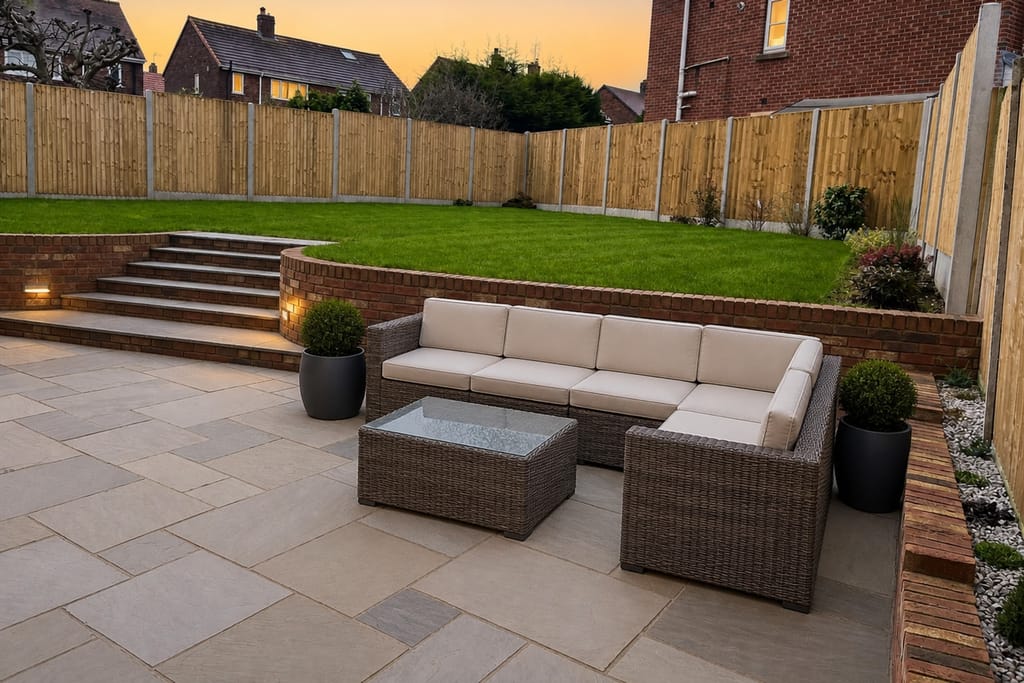
What goes under the flags
A patio is a small building job with a nice finish on it. Under the stone there is compacted sub-base, and under that is whatever your garden happens to be made of, which round here is often clay that moves with the weather or ground made up at some point. So we dig out and look before committing to a build-up. Then every flag goes down on a full wet bed of mortar. Not five dabs at the corners and one in the middle, which is quick and cheap and leaves a void under each flag for water to sit in and frost to work on.
The flag sizes decide what patterns you can have
This is the bit worth understanding before you choose a stone, because it changes how the finished patio reads. The simple rule is that the more sizes in the pack, the more layouts open up to you. Patterns run from the plainest, a stack bond in a single size with the joints lining through in both directions, out to a repeatable random using four or five different flag sizes so the eye never quite finds the repeat. In between there is running bond, which offsets each row, and the various half and quarter patterns that use two sizes together.
None of that means a single size is a poor choice. Even with one flag you can lay stack bond, running bond, or turn the whole grid to 45 degrees and change the feel of a small garden completely. A single size keeps the cutting simple and the look calm, which suits a modern extension. A multi-size pack suits an older house and a bigger area, where a dead regular grid can read like a car park.
Circles and curves
A circle feature is a proper way of breaking up a large rectangle, and it gives you a natural spot for a table or a fire pit. The circle itself comes as a kit of tapered stones, but the work is in the ring around it, where the square flags have to be cut to meet the curve with an even joint the whole way round. That is bench saw work and it takes time, and it is where you can see straight away whether the patio was laid by somebody in a hurry. The same goes for curved edges to a lawn or a border. Both are worth having and both are worth paying for someone to do slowly.
The stone itself
Indian sandstone is what most patios round here get laid in, and for good reason: it wears well, and it comes in a proper range of colours from buff and grey through the greens to the dark blue blacks. Riven stone has the split face and the slight variation in thickness that goes with it. Sawn and calibrated stone is more even, which suits a formal layout. Whichever you pick, ask to see it wet as well as dry, because stone looks very different in the rain and you will see plenty of that in Yorkshire.
How we work in your garden
Access is usually through the house or down the side, so we sheet up, barrow rather than run a machine over your lawn where the gap is tight, and sweep and tidy at the end of every day rather than only at the end of the job. That comes up more than anything else in our reviews. It is a mucky job and we would rather it did not feel like one. Once we start we stay on it until it is finished, and it is Mark and his own lads on site, not a sub-contract gang. Patios often want steps down to a lawn or a low retaining wall to hold a level, and plenty end up with a barbecue or a pizza oven built into a corner.
Questions we get asked about this
Why not bed the flags on five dabs of mortar?
Because a flag on five dabs is hollow underneath, and everything that goes wrong with a patio starts in that void. Water gets in and sits there, frost lifts the flag off its dabs, the corners crack where somebody stands on an unsupported edge, and the joint opens up and lets more water in. Tap across an old patio and you can hear which ones were done that way. Every flag we lay goes on a full wet bed of mortar with the stone primed on the back where it needs it, so there is nothing under it but mortar. It uses more material and it takes longer, and it is the difference between a patio that lasts and one that is lifting in five years.
Will Indian stone go green on us?
It can, on the shaded side, under trees, or anywhere that stays damp because the water has nowhere to run. Natural stone is porous, that is part of why it looks like stone and not like concrete. Most of the greening people complain about is a drainage problem rather than a stone problem, which is why we spend the time getting the falls right rather than laying it dead level and hoping. A brush down once or twice a year keeps on top of it. If you want the colour held closer to how it looks wet, a sealer will do that, though it is a job you repeat every few years and plenty of people prefer to let the stone weather.
Can the patio come right up to the back of the house?
Yes, and it usually should, but the finished surface has to sit well below the damp proof course in the brickwork so nothing bridges it. Where the levels are tight, and on a lot of these houses they are, the answer is a drainage channel along the wall taking the water away, or dropping the patio a step down from the threshold. What we will not do is build the level up against the brick to save a step, because that is how you get damp inside a year or two. We work all of that out at the survey with a level rather than by eye.
Talk to us about your patio
We will come out at a time that suits you, take the measurements, look at the levels and put a full price in writing. A family owned firm, and the visit costs you nothing.