
Driveways in Wakefield and the towns around it
Block paving, tarmac and natural stone. The surface is what you look at, but the dig out, the sub-base, the edgings and the drainage underneath decide whether it still looks like that in ten years.
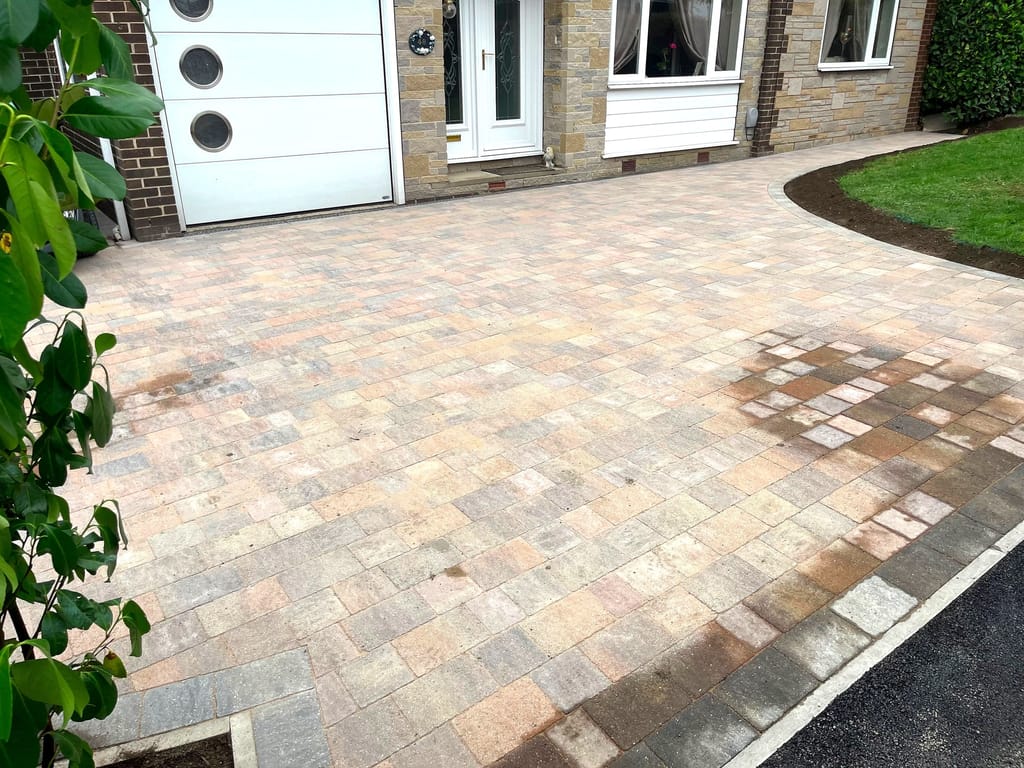
What is actually holding a drive up
A drive that has gone wavy in the wheel tracks or dropped away from its edging almost never failed at the surface. It failed underneath. Either the ground was not taken out deep enough, or the stone went in as one thick layer instead of several thin compacted ones, or there was nothing haunched round the perimeter to stop it spreading sideways. None of that shows on the day it is finished, which is why it is the part a cheap price trims out. Ask every firm quoting you how deep they are digging and what the edgings are bedded on.
The surfaces we lay
Three, and they are not ranked. We are happy to talk through the suitability of each against how the drive gets used.
Block paving
Concrete or clay blocks bedded on sharp sand over the compacted stone, with a soldier course and a concrete haunch round the perimeter. The reason to pick blocks is that they come apart again. When a utility digs up your service, or a root lifts a corner, we pull the blocks, sort the ground and relay the same ones, so there is no patch scarred across a solid surface. Herringbone at 45 degrees interlocks best where cars turn and brake. Where a drive is being extended rather than replaced, the old blocks can often be lifted, cleaned and mixed in with matching new ones.
Tarmac
Laid hot over the same compacted sub-base, in a base course and a wearing course, and rolled while it is still hot. It needs something firm to be rolled up against, so it gets a block or kerb edge rather than being left to crumble at the margins. Tarmac earns its place on long drives and shared entrances, where a large area of block would be slow and dear. The surfacing itself is laid by our partners, onto the base we have built. It wants a dry warm run at it, so we watch the forecast. There is more on the tarmac page.
Natural stone
Sandstone setts, stone flags and stone edgings, usually where the house or the boundary wall is stone. It is the dearest of the three and the slowest to lay, but on the right frontage nothing else looks like it. Setts take a car well because the units are small and deep. Flags need choosing carefully, because one sized for a patio will not automatically take a vehicle.
Dropped kerbs
If a car has to cross the footway to reach the new drive, that crossing belongs to the council rather than to us. Wakefield, Ossett, Horbury, Normanton, Pontefract and Castleford go through Wakefield Council. We arrange it with you and build the drive up to the boundary so the two meet properly, and we say at the survey if the frontage looks too shallow for a car to stand clear of the pavement.
How the job runs
- Survey. Measure up, check the fall, see where the water goes and what is under the old surface.
- Dig out. Down to formation, spoil carted away rather than piled on your lawn.
- Sub-base. Stone in layers, compacted between each, graded to fall away from the house.
- Edgings. Set on concrete and haunched, before any surface is laid.
- Drainage. Channel drains, a soakaway or a border to take the run-off.
- Surface. Blocks laid off the pattern and cut wet, or the tarmac surfacing laid and rolled hot.
- Finish. Joints sanded, edges cleaned off, site swept, aftercare explained.
Keeping it right afterwards
Block: top the joint sand up after the first year and every few years after, and pull weeds before they root under a block. Pressure wash with a wide fan rather than a narrow lance held close, and re-sand the same day. Tarmac: keep diesel and oil off it. Stone: brush it and lift moss on the shaded side. Drives run into the rest of the frontage, so walling and steps are worth pricing while the machines are here. Finished drives are in the gallery, and how we quote covers the rest.
Questions we get asked about this
Do I need a dropped kerb, and who arranges it?
You need one wherever a car has to cross the footway to get onto the drive, and the crossing itself is the council's job rather than ours. For Wakefield, Ossett, Horbury, Normanton, Pontefract and Castleford that goes through Wakefield Council. They look at whether the frontage is deep enough for a car to stand fully clear of the pavement, what is buried under the verge, and whether you can see up and down the road safely. We are happy to help you get the application in and to sequence our work around it, because the drive and the crossing have to meet neatly at the boundary. Fees and requirements are the council's and they change, so take the current position from them.
Can the new drive go straight over the old concrete?
Not for block paving. Blocks want a flexible sub-base with a sand bed on top of it, and laying them over an old slab is how you end up with ripples in the wheel tracks after a couple of winters. Tarmac is a bit different: if the concrete is genuinely sound, flat and still draining, an overlay is sometimes worth talking about, though cracks in a slab have a habit of coming back up through the tarmac in the same place. What we will not do is cover something up to save a day on the dig and let you find out later. We tell you which of those you have when we come out and look.
How long are we without the drive, and where does the muck go?
A normal domestic drive is a week to a few weeks on site, and we will give you the run of days in the written quotation so you can plan the car around it. What we will not do is start yours, disappear onto another job and come back the following week. Once we start, we stay on it until it is finished. The spoil from the dig goes into a grab or a skip and off site the same way it came out, we keep the road swept while the wagons are coming and going, and on the last day the edges get cleaned off and the site swept before we leave.
Get a price for your drive
Tell us the postcode and roughly what you are after. We come out at a time that suits you, measure up and put a full price in writing. The visit costs nothing and there is no deposit. Our Google rating is 5.0 from 25 reviews.